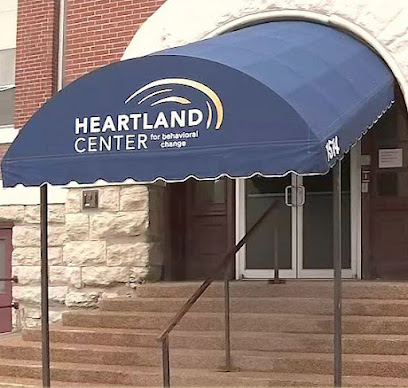
Heartland Center for Behavioral Change (HCBC) operates at 1534 Campbell Street in Kansas City, Missouri, with an additional contact location at 1730 Prospect Avenue (64127) listed on the public website. The published phone line is (816) 421-6670, and HCBC is reachable by mail at the Campbell Street address. The organization’s stated mission is to provide behavioral healthcare and substance use disorder treatment services to help individuals lead healthier, happier, more productive lives.
HCBC carries dual external validation: CARF International accreditation and certification by the Missouri Department of Mental Health. Both credentials appear on the public website with logos and reference links, and CARF is also confirmed in SAMHSA’s federal record. SAMHSA additionally records the program as a Substance Use Treatment facility with Cognitive Behavioral Therapy as the primary therapeutic method and explicit clinical capacity for Trauma/PTSD and co-occurring disorders.
SAMHSA confirms outpatient and Intensive Outpatient (IOP) levels of care. Although SAMHSA’s raw record flags a detox category, the residential flag is not affirmative and the HCBC public website does not confirm an on-site medical detox unit, so this listing does not claim detox capacity. Prospective clients seeking medical withdrawal management should call to confirm whether the program coordinates detox externally or operates a service line not yet reflected on the public site.
Populations served per SAMHSA include pregnant women, seniors and older adults, men, women, and court-ordered clients. Accepted payment methods per SAMHSA are Medicaid, sliding scale, and financial assistance — a payor mix oriented to low-income and uninsured Kansas City residents. Specific in-network insurance carriers are not enumerated and are not invented here. The program serves clients in English per SAMHSA’s language record.
CARF International-accredited and certified by the Missouri Department of Mental Health
Outpatient and Intensive Outpatient (IOP) levels of care per SAMHSA
Specialty service for pregnant women, seniors, and court-ordered clients
Trauma-informed CBT plus co-occurring disorder capacity per SAMHSA
Payment model oriented to access: Medicaid, sliding scale, and financial assistance
HCBC carries both CARF International accreditation and Missouri Department of Mental Health certification — two independent external credentials. CARF is also reflected in SAMHSA's federal record. For families weighing programs in the Kansas City area, that paired validation is uncommon and meaningful.
Built for Specialty Populations
Pregnant women, seniors, and court-ordered clients each face distinct clinical, legal, and practical barriers to substance use treatment. SAMHSA's population flags for HCBC explicitly include all three groups, in addition to general men's and women's tracks. That breadth is unusual at an outpatient-focused program.
An Access-Oriented Payment Model
Medicaid, sliding scale, and financial assistance — the SAMHSA-confirmed payment mix — signals that HCBC is structured to serve low-income and uninsured Kansas City residents rather than primarily private-pay clientele. Verify benefits and any sliding-scale eligibility documentation by phone before scheduling an intake.
Cost & Credentials
What's covered and who vouches for it
Payment options
MedicaidSliding ScaleFinancial Assistance
Accreditations
CARFMissouri Department of Mental Health
Common questions
FAQs About Heartland Center for Behavioral Change
Where is Heartland Center for Behavioral Change located?+
The directory lists 1534 Campbell Street, Kansas City, Missouri 64108, while the public website prominently displays a 1730 Prospect Avenue (64127) contact location. Phone: (816) 421-6670.
Is the program accredited?+
Yes. HCBC is accredited by CARF International and is certified by the Missouri Department of Mental Health. Both credentials are displayed on the public website.
What levels of care does HCBC provide?+
SAMHSA confirms outpatient programming and Intensive Outpatient (IOP). The website does not confirm on-site medical detoxification, so withdrawal management services should be verified by phone.
Who does the program serve?+
Per SAMHSA, populations served include pregnant women, seniors and older adults, men, women, and court-ordered clients. Trauma/PTSD and co-occurring disorders are explicitly within the clinical scope.
What payment methods are accepted?+
Per SAMHSA: Medicaid, sliding scale, and financial assistance. The payment mix is oriented to access for low-income and uninsured clients. Specific in-network insurance carriers are not enumerated.
What clinical approach does HCBC use?+
Cognitive Behavioral Therapy is the primary therapeutic method recorded in SAMHSA's data. Trauma/PTSD and Co-Occurring Disorders / Dual Diagnosis are within the program's clinical scope.
Does HCBC support pregnant women specifically?+
Yes. SAMHSA's population data explicitly flags pregnant women as a served population, which is a clinically meaningful designation since pregnancy-related substance use care requires specialized coordination with prenatal providers.
Services
Programs and specialties
Treatment type
Hospital inpatientOutpatientInpatient medical detox and stabilizationIOPOutpatient methadone/buprenorphine or naltrexone treatmentAftercare recovery programsAlcohol DetoxificationCocaine DetoxificationOpioid DetoxificationMethamphetamines detoxificationRoutinely uses medication for detoxification
Payment
Cash or self-paymentFederal or any government funding for substance use programsMedicaidSliding fee scale (fee is based on income and other factors)
Specialty
Mental health counseling for co-occurring disordersGroup therapyAddiction recovery educationClients referred from the court/judicial system
If you are seeking drug and alcohol related addiction rehab for yourself or a loved one,
the sponsored hotline is a confidential and convenient solution.
Calls to any sponsored hotline (non-facility) will be answered by: